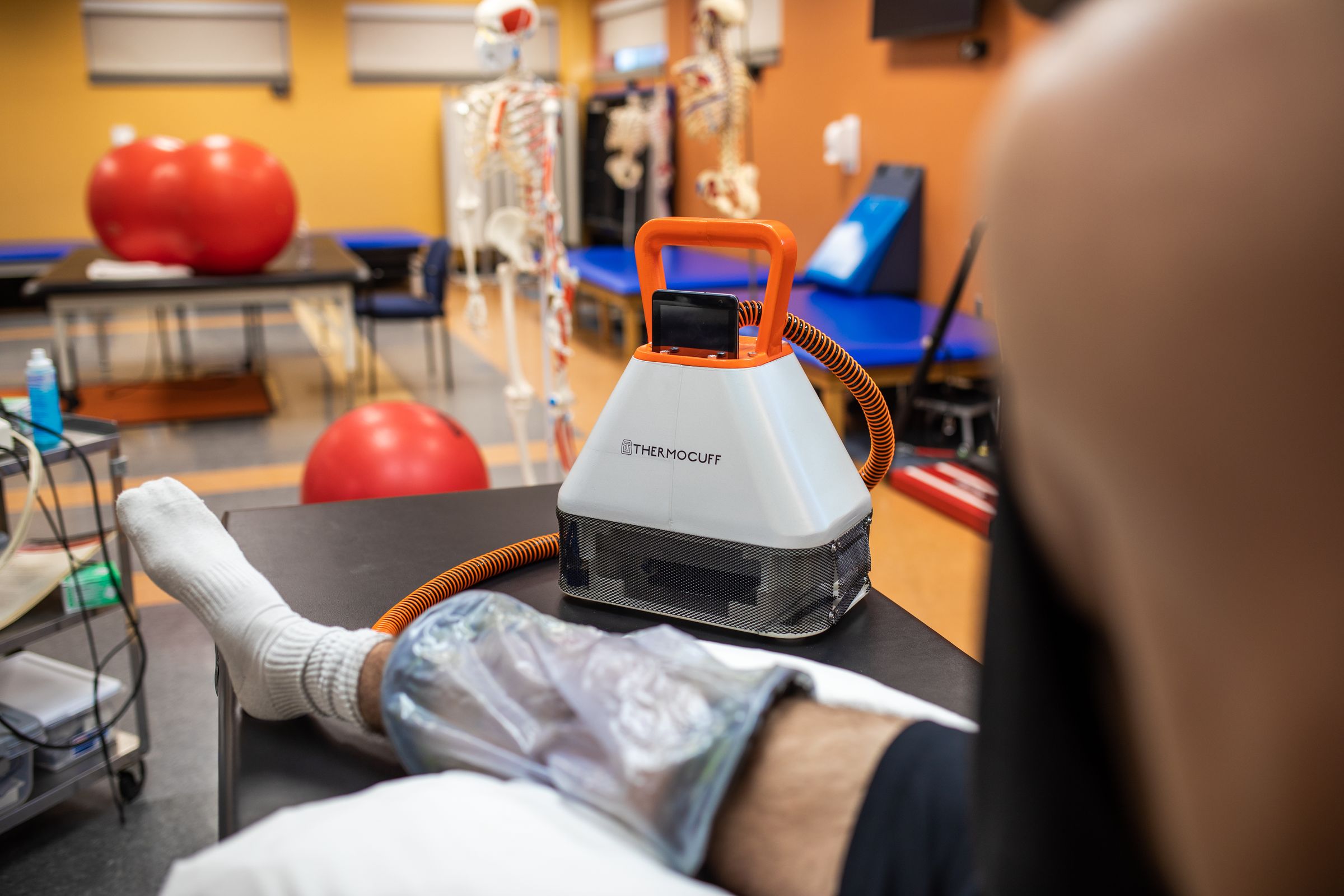
Forced-air thermal therapy.
ThermoCuff pushes temperature-controlled air through a sealed cuff around the limb. The air keeps moving, so the skin is never sitting against something that has already warmed up or cooled down.
How it works
Ice packs and ice-water wraps work by conduction. A cold surface sits on the skin and heat flows into it until the two temperatures meet. The pad warms up as it works, and in a circulating unit the water picks up heat from the body and the room, so the temperature at the skin creeps up over the session.
ThermoCuff uses forced convection instead. The thermoelectric core cools or heats the air, a blower pushes it through the cuff, and air that has exchanged heat with the limb is carried back and replaced. It's the difference between a convection oven and a skillet: moving air keeps a fresh temperature difference at the surface, and that difference is what drives heat transfer.
- Thermoelectric core. Solid-state modules handle both cooling and heating, with no compressor, refrigerant, ice, or water.
- Closed-loop control. Sensors read the air temperature at the cuff, and the controller adjusts continuously to hold the set point within about a degree.
- Adjustable airflow. The nozzle can focus air on one spot, like an irritated tendon, or spread it around a swollen joint.
- Sealed, single-use cuff. Only air touches the cuff, so it can be disposable. The snug fit also adds light, even pressure around the limb.
Air leaves the console at 52°F, draws heat out of the tissue as it circles the limb, and returns warmer to be cooled again.
Backed by peer-reviewed research
World Journal of Experimental Medicine, September 2026
Convection-based vs conduction-based cooling in rehabilitation: a cadaveric porcine study of surface and intra-articular temperature reduction
Ibrahim MA, Abdelhameed B, Beltagi A, et al.
Read the study →Most of what needs treating isn't at the skin. Ligaments, tendons, the joint capsule and the synovial fluid inside it, and muscle lying close to bone all sit under layers of skin and fat that insulate them. Surface cold numbs the skin quickly but reaches those structures slowly, and an ice pack has usually warmed up before it gets there.
A peer-reviewed study in the World Journal of Experimental Medicine measured this directly. Orthopedic and rehabilitation researchers placed temperature probes under the skin, in the muscle, and inside the knee joint of a cadaveric pig leg, then compared ThermoCuff with two circulating-pad cooling systems at the same 35°F target. After 20 minutes, ThermoCuff had lowered the temperature inside the joint by 18°F, about 2.5 times more than the next-best system, and the tissue under the skin by 26.6°F.
Cold slows local metabolism and nerve conduction in the tissue it reaches. Heat increases blood flow and makes muscle and connective tissue more extensible, and synovial fluid becomes less viscous as it warms. ThermoCuff holds either set point for as long as a session runs and switches between them in under 30 seconds for contrast work.
Under the skin
Change in °F after 20 minutes
In the muscle
Change in °F after 20 minutes
Inside the joint
Change in °F after 20 minutes
Show the data table
| Change at 20 minutes | Under the skin | In the muscle | Inside the joint |
|---|---|---|---|
| ThermoCuff | −26.6°F (−14.8°C) | −3.2°F (−1.8°C) | −18.0°F (−10.0°C) |
| SootheAway 2 | −15.1°F (−8.4°C) | −2.3°F (−1.3°C) | −7.0°F (−3.9°C) |
| SootheAway 1 | −7.0°F (−3.9°C) | +11.7°F (+6.5°C) | +8.6°F (+4.8°C) |
| No cooling | −3.2°F (−1.8°C) | −0.7°F (−0.4°C) | −5.9°F (−3.3°C) |
Compared with ice and water
- ThermoCuff
- Forced-air convection
- Ice-water circulating units
- Conduction through a water bladder
- Thermoelectric water units
- Conduction through a water bladder
- Ice packs
- Conduction
- ThermoCuff
- Held at set point, ±1°F
- Ice-water circulating units
- Drifts warmer as the ice melts
- Thermoelectric water units
- Held steady
- Ice packs
- Warms within minutes
- ThermoCuff
- Yes, same cuff
- Ice-water circulating units
- Cold only on most models
- Thermoelectric water units
- Cold only on most models
- Ice packs
- Separate heat pack
- ThermoCuff
- Built in, under 30s to switch
- Ice-water circulating units
- No
- Thermoelectric water units
- No
- Ice packs
- Manual swapping
- ThermoCuff
- Neither
- Ice-water circulating units
- Ice and water
- Thermoelectric water units
- Water
- Ice packs
- Ice
- ThermoCuff
- Single-use
- Ice-water circulating units
- Reusable, cleaned between patients
- Thermoelectric water units
- Reusable, cleaned between patients
- Ice packs
- Reusable
Specifications
- Delivery medium
- Temperature-controlled air, forced convection
- Thermal engine
- Solid-state thermoelectric, heats and cools
- Cold set point
- 52°F
- Heat set point
- 104°F
- Hold accuracy
- ±1°F at the cuff
- Hot to cold switch
- Under 30 seconds
- Joint cooling at 20 minutes
- −18°F (−10°C), 2.5× the next-best circulating-pad system (cadaveric knee study, 2026)
- Cuff
- Full wrap, 12 × 16.5 in, dual 2 in inlet and outlet ports, single-patient
- Console weight
- Under 10 lb
- Patents
- Issued in the US, Canada, China, and Japan
- Regulatory status
- Pursuing FDA Class II 510(k) clearance
We're happy to walk therapists, trainers, and investors through the test data and the engineering behind it.
Contact Us →